Memoirs of a French Village ÃⰠChronicles of Prairie Du Rocher Reviews
| Prairie du Rocher | |
|---|---|
| Village | |
 A grain elevator in Prairie du Rocher | |
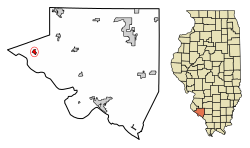 Location of Prairie du Rocher in Randolph County, Illinois. | |
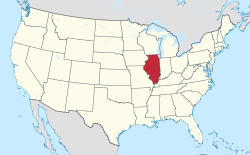 Location of Illinois in the Usa | |
| Coordinates: 38°04′59″N 90°05′45″Due west / 38.08306°N 90.09583°Westward / 38.08306; -xc.09583 Coordinates: 38°04′59″N 90°05′45″W / 38.08306°Due north ninety.09583°W / 38.08306; -90.09583 | |
| Country | United States |
| Country | Illinois |
| County | Randolph |
| Precinct | Prairie du Rocher |
| Founded | 1722 |
| Expanse [1] | |
| • Full | 0.57 sq mi (1.48 km2) |
| • State | 0.57 sq mi (1.48 kmtwo) |
| • Water | 0.00 sq mi (0.00 km2) |
| Elevation | 394 ft (120 m) |
| Population (2020) | |
| • Total | 502 |
| • Density | 879.16/sq mi (339.24/kmtwo) |
| Time zone | UTC-6 (CST) |
| • Summer (DST) | UTC-5 (CDT) |
| Nothing Code(s) | 62277 |
| Surface area code(due south) | 618 |
| FIPS code | 17-61639 |
Prairie du Rocher ("The Rock Prairie" in French) is a village in Randolph County, Illinois, U.s.. Founded in the French colonial period in the American Midwest, the community is located near bluffs that flank the east side of the Mississippi River along the floodplain oft chosen the "American Bottom". The population was 502 at the 2020 census.[ii]
Prairie du Rocher is ane of the oldest communities in the 21st century The states that was founded as a French settlement. About four miles to the west, closer to the Mississippi River, is Fort de Chartres, site of a French armed forces fortification and colonial headquarters established in 1720. Some buildings were reconstructed after falling into ruins, and the complex is at present a state park and historical site. The fort and boondocks were a heart of government and commerce at the time when France claimed a vast territory in North America, New France or La Louisiane, which stretched from present-day Louisiana and the Illinois Country to Canada.
The hamlet was founded in 1722 by French colonists, mostly migrants from Canada.
History [edit]
New France [edit]
In 1718, Pierre Dugué de Boisbriand built the start Fort de Chartres. In 1722, St. Thérèse Langlois, a nephew of Boisbriand, founded Prairie du Rocher. The town was built on a tract of country donated by the Royal Indian Company. Boisbriand later became the commandant of the area. The town was strategically located forth fertile Mississippi River bottomland. Surpluses from the productive tillage past habitants later helped supply critical wheat and corn to New Orleans and other lower Louisiana Territory communities.[iii] [iv]
D'Artaguette, an inspector in the country in the early on 18th century, wrote:
This country is 1 of the most beautiful in all Louisiana. Every kind of grain and vegetables are produced here in the greatest abundance .... they take, also, big numbers of oxen, cows, sheep, etc., upon the prairies. Poultry is abundant, and fish plentiful. So that, in fact, they lack none of the necessaries or conveniences of life.[v] [6]
In 1743 the territorial government granted the Prairie du Rocher Common (land used by all the villagers) to the hamlet; the common was used until 1852. The villagers had plots for cultivation defined in typical French fashion: long narrow lots that reached dorsum from the riverfront through the common. The villagers kept the plots open up within the common, and built a debate around it to keep out livestock.[vii] A schoolhouse existed as early as the 1760s; students boarded with local families.

French Colonial Illinois Land
Considering habitants did not exercise fertilization, the soil became wearied. In addition, an increment in population meant there was not sufficient land for anybody. Some villagers moved to the w side of the Mississippi and founded Ste. Genevieve about 1750, in present-day Missouri. They rapidly created an agronomical community with characteristics like to Prairie du Rocher.[8]
British rule [edit]
Following their victory in the French and Indian War (likewise known as the 7 Years' War), the British gained possession of French lands east of the Mississippi, excluding New Orleans. The Treaty of Paris was signed in 1763; all the same, the British did not get in in forcefulness until 1765. To avert British dominion, many of the town'southward French residents moved across the Mississippi River to towns such as Ste. Genevieve and St. Louis in what was now, via the secret Treaty of Fontainebleau, Spanish Louisiana. Additionally, Rex George Three's Regal Proclamation of 1763 designated all the land west of the Appalachians and east of the Mississippi an Indian Reserve. He tried to foreclose settlers entering from the and so-British Colonies.[9] [10]
American Revolution [edit]
During the American Revolutionary War, George Rogers Clark captured Prairie du Rocher for the colonies in his Illinois entrada that likewise resulted in the capture of Vincennes, Indiana. Reportedly, his campaign caused some of the remaining French settlers to emigrate to the Castilian-controlled territories westward of the Mississippi, leaving relatively few in Prairie du Rocher. Many of the subsequent settlers of the surface area had been members of Clark'southward campaign, or were related to someone who was. They were convinced of the promise of the area by tales of the fertility of the soil in the area now called American Bottom.[xi]
1993 floods [edit]
Prairie du Rocher was 1 of the few towns forth the Mississippi River that escaped being flooded in the Great Flood of 1993. Later on levees bankrupt to the north well-nigh the towns of Columbia and Valmeyer, Illinois, overflowing waters engulfed Fort de Chartres. They also threatened the town of Prairie du Rocher.
With but the Prairie du Rocher Creek levee protecting the town, residents discovered a unique situation had developed. The water that had broken through the master Mississippi River levee and was approaching the top of the Prairie du Rocher Creek levee was higher than the water in the main Mississippi River aqueduct. The Army Corps of Engineers (COE) decided to use a barge-mounted shovel to pause through the Mississippi River levee nigh Fort de Chartres, to allow alluvion waters to escape back to the Mississippi River channel. This did not significantly lower the h2o level, simply the COE decided against further action.
In a 3:30 a.m. decision, with the overflowing waters at the tiptop of the sandbags stacked on top of the Prairie du Rocher Creek levee, all three commissioners of the Fort de Chartres – Ivy Landing Drainage and Levee Commune voted to employ dynamite to breach the levee in two additional locations. Considering of hazard, the COE had argued against such a determination. The hamlet put out a phone call for help and added a pes and a half of sandbags to the creek levee. Finally, the two openings allowed enough water to escape back to the master channel so that the town was saved from flooding.[12] The levee nonetheless stands potent today.
Recent history [edit]

French settlers founded Prairie du Rocher circa 1722. At least twelve surviving houses in the village were built in the eighteenth century, including the Melliere Business firm, which was constructed in 1735.[13] Another is the Creole Business firm,[xiv] constructed in 1800,[15] which was built in the French Colonial mode by an unknown English-speaking immigrant from the eastern United States.[16]
Arts and civilization [edit]
French customs expert in Prairie du Rocher include La Guiannée, a custom of caroling on New year's day's Eve dating back to medieval times in France. Information technology has been celebrated in Prairie du Rocher every New year's Eve since settlement in 1722. The town as well celebrates Rendezvous during the summertime, as well as the winter, at the Fort de Chartres. During that time, people from a broad area come to military camp out for the weekend. They dress like Indians and French soldiers of the mid-18th century, campsite out at the fort, and re-enact the wars that decided the buying of the fort.[17]
Fort de Chartres is a French war machine fort constructed in the 18th century. It later on was designated an Illinois state historic site.
Geography [edit]
According to the 2010 demography, Prairie du Rocher has a total area of 0.57 foursquare miles (ane.48 km2), all state.[xviii]
Illinois Road 155 is the only land highway that runs through Prairie du Rocher. It connects the town with Ruma, seven miles (xi km) to the northeast, and Fort de Chartres, 4 miles (6 km) to the west. Barefaced Road connects the town to as far southward as Ellis Grove and every bit far n as Columbia.
Demographics [edit]
| Historical population | |||
|---|---|---|---|
| Census | Popular. | %± | |
| 1880 | 228 | — | |
| 1890 | 408 | 78.nine% | |
| 1900 | 347 | −xv.0% | |
| 1910 | 511 | 47.3% | |
| 1920 | 535 | four.vii% | |
| 1930 | 510 | −four.7% | |
| 1940 | 576 | 12.9% | |
| 1950 | 662 | 14.9% | |
| 1960 | 679 | ii.6% | |
| 1970 | 658 | −3.1% | |
| 1980 | 701 | 6.v% | |
| 1990 | 540 | −23.0% | |
| 2000 | 613 | 13.5% | |
| 2010 | 604 | −1.v% | |
| 2020 | 502 | −16.9% | |
| U.S. Decennial Census[nineteen] | |||
As of the demography[20] of 2000, there were 613 people, 240 households, and 160 families residing in the village. The population density was 1,076.2 people per foursquare mile (415.2/km2). There were 255 housing units at an average density of 447.vii per square mile (172.7/kmii). The racial makeup of the village was 99.02% White, 0.33% Native American, and 0.65% from ii or more races.
There were 240 households, out of which 39.2% had children under the age of 18 living with them, 52.5% were married couples living together, 9.2% had a female householder with no husband present, and 33.iii% were non-families. 28.three% of all households were fabricated up of individuals, and 12.9% had someone living lonely who was 65 years of age or older. The average household size was two.55 and the average family size was 3.sixteen.
In the village, the population was spread out, with 29.ii% under the age of 18, 9.v% from xviii to 24, 27.two% from 25 to 44, 22.0% from 45 to 64, and 12.1% who were 65 years of age or older. The median age was 34 years. For every 100 females, there were 81.4 males. For every 100 females age 18 and over, there were 89.5 males.
The median income for a household in the village was $35,795, and the median income for a family was $44,659. Males had a median income of $31,750 versus $xx,556 for females. The per capita income for the village was $xiv,771. About 9.3% of families and 8.3% of the population were below the poverty line, including six.3% of those under age 18 and 14.three% of those age 65 or over.
Education [edit]
The town has one elementary school for grades Thousand-8. Students must travel to a nearby town for loftier school. The village has a library and two parks, one owned past the school and the other by the town. Myers Korner Market place occupies a corner.
Infrastructure [edit]
The volunteer fire department occupies role of the metropolis hall (which also houses the post office).
Notable people [edit]
- Henry C. Hansbrough, U.South. Congressman and Senator from Northward Dakota
Gallery [edit]
-

Route sign
-
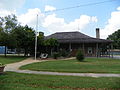
French-Colonial manner house
-

St. Joseph Roman Cosmic Church
External links [edit]
- "Illinois Boondocks Cuts Levee Against Federal Advice", The Randolph County Herald Tribune
- The New York Times
References [edit]
- ^ "2020 U.S. Gazetteer Files". Usa Census Bureau. Retrieved March xv, 2022.
- ^ "Explore Demography Data".
- ^ Fadler, T.P. (Theodore P.) (1972). "Missouri Memoirs of a French Village: a chronicle of sometime Prairie du Rocher, 1722–1972". Retrieved 2015-07-fifteen .
- ^ John A. Walthall (1991). French Colonial Archeology: The Illinois Country and the Western Great Lakes. ISBN9780252017971.
- ^ Margaret Kimball Brown, "French Colony Survivors in the Illinois State" Archived 2012-08-05 at archive.today, Northern Illinois University Library, Retrieved on January 24, 2008
- ^ Francis Parkman (1870). "The Conspiracy of Pontiac and the Indian War after the Conquest of Canada".
- ^ "Company's Guide to Prairie du Rocher – Randolph County, Illinois" Archived 2008-06-ten at the Wayback Auto, Great River Road
- ^ Carl J. Ekberg, Colonial Ste. Genevieve: An Take a chance on the Mississippi Borderland, Gerald, MO: The Patrice Press, 1985, p. 25
- ^ Carl J. Ekberg; Sharon K. Person (2015). St. Louis Ascension: The French Regime of Louis St. Ange de Bellerive. ISBN9780252096938.
- ^ M. J. Morgan (2010). Land of Large Rivers: French and Indian Illinois, 1699–1778. ISBN9780809385645.
- ^ Clarence Edwin Carter (1910). "Great Britain and the Illinois Country, 1763–1774". American Historical Association: vii.
prairie du rocher british.
- ^ Verhovek, Sam. "The Midwest Flooding; Illinois Town Cuts Levee Confronting Federal Advice", New York Times, 5 August 1993, accessed 29 Sep 2009
- ^ Brown, Margaret K. National Register of Historic Places Inventory/Nomination: French Colonial Celebrated District. National Park Service, n.d., two
- ^ Gilster, Ruth, and A. Hahn. National Annals of Celebrated Places Inventory/Nomination: Creole House. National Park Service, n.d., 2
- ^ "National Annals Information Organization". National Register of Historic Places. National Park Service. July 9, 2010.
- ^ Drury, John. Old Illinois Houses. Champaign: Illinois State Historical Society, 1948, 4–6.
- ^ Laura E. Stirnaman (1996). "La Guiannee Tradition of Prairie du Rocher". Archived from the original on 2015-07-16. Retrieved 2015-07-15 .
- ^ "G001 - Geographic Identifiers - 2010 Census Summary File 1". United States Demography Agency. Archived from the original on 2020-02-13. Retrieved 2015-12-25 .
- ^ "Explore Demography Data".
- ^ "U.S. Demography website". U.s.a. Census Bureau. Retrieved 2008-01-31 .
Source: https://en.wikipedia.org/wiki/Prairie_du_Rocher,_Illinois
0 Response to "Memoirs of a French Village ÃⰠChronicles of Prairie Du Rocher Reviews"
Post a Comment